
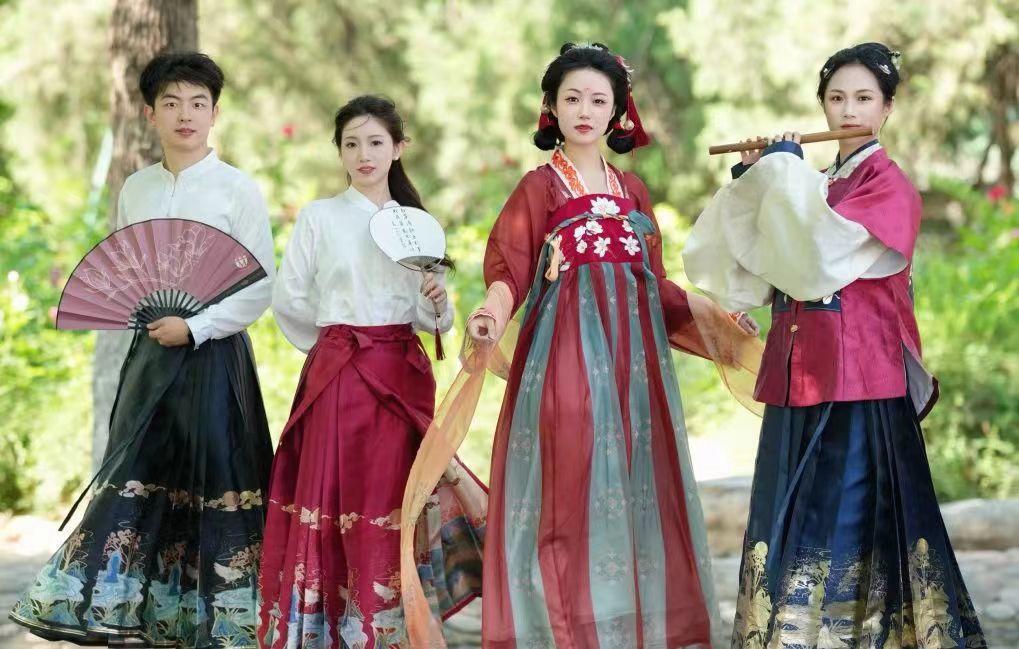
When Shandong Youth Political Science University staged its “Shanqing Chinese Academic Gown Release Show” in early 2026, the runway featured not Western-cut gowns that have defined Chinese commencement ceremonies since 1994, but Ming-dynasty-inflected hanfu hybrids: pipa-sleeve jackets, horse-face skirts, and a “triple-layer cloud-shoulder” cut developed jointly with a vocational university 200 kilometers away. The display signaled that Caoxian County — a town in Heze, Shandong, better known as the source of roughly half of China’s off-the-rack hanfu — had opened a new product line: Chinese-style academic regalia.
Behind a single show lies a coordinated industrial pivot. According to local industry coverage, Caoxian has assembled what insiders call a “five-kilometer full industrial chain” — from pattern design and digital printing to embroidery, finished-garment assembly, and even the gift boxes used to package each gown — all reachable within a 5-kilometer radius of Daji Town, the county’s production core. By late spring 2026, the cluster had locked in design partnerships with 13 Chinese universities, with eight schools set to gown roughly 18,000 graduating students in custom Chinese academic regalia this commencement season.
Street-Side Hanfu to Commencement Hall
Caoxian’s graduation-gown push is a deliberate departure from the commodity hanfu that has made the county famous. The county’s broader hanfu complex has been covered extensively elsewhere — billion-yuan revenues, livestream-driven exports to more than 30 countries — but the academic-regalia line is a different beast. Where standard hanfu is sold by the piece to individual buyers, each academic gown is a custom, school-specific garment: the school crest, motto, and regional heritage are woven into a design that has to be both ceremony-ready and comfortable enough to wear to a graduation photo session, then out to dinner afterwards.
“The national academic-gown standard dates to 1994 and has barely moved since,” designer Chen Long told local industry press. Chen, who operates a design studio inside the Daji Town cluster, has spent the past year embedding school crests, mottos, and regional motifs into Ming-form hanfu — pipa sleeves and horse-face skirts mostly — while shortening hems and tapering cuts so the gowns read as ceremony wear on stage and as streetwear after.
He is not working alone. The “triple-layer cloud-shoulder” degree gown on display at the Shanqing show was developed with the School of Costume and Fashion Design at Henan Science and Technology Vocational University, whose team embedded the imagery of Zhoukou’s “three-river confluence” geography into the cloud-shoulder embroidery. Gao Hanying, a faculty member on that team, framed the work as a literal “industry chain design class” — students work on real orders, learn real pattern-making, and graduate with a portfolio piece already on the body of a 2026 graduate.
Five Kilometers, One Gown
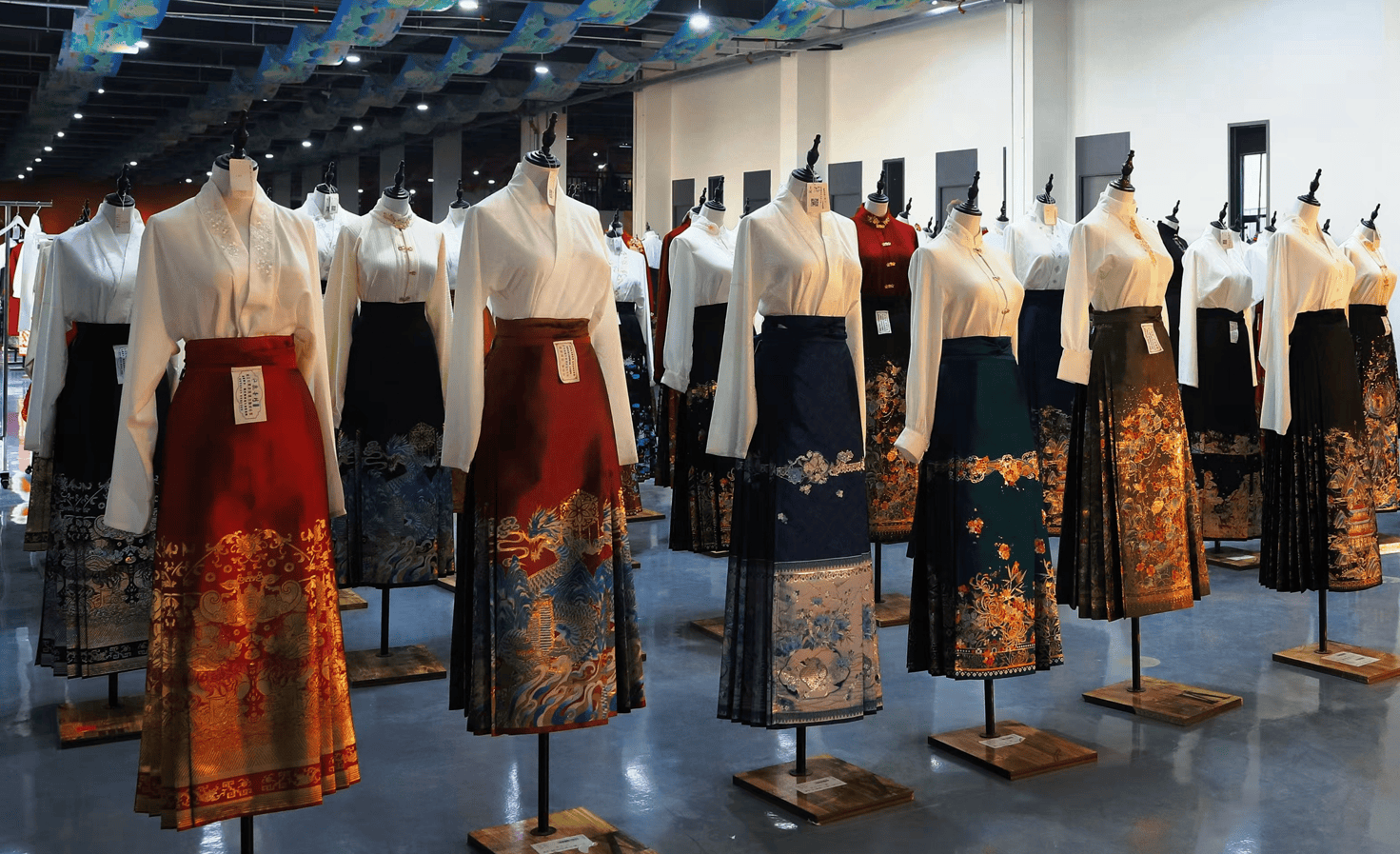
The speed of the model comes from physical proximity. Local reporting from Daji Town describes a vertical supply chain so compressed that a single hanfu — or a single Chinese academic gown — can move from fabric to gift-boxed finished product without leaving the neighborhood. Fabric mills, digital printers, embroidery workshops, cutting rooms, and packaging lines all sit within a 5-kilometer loop. For a graduation-gown order that has to be cut, embroidered with a school-specific motif, quality-checked, and shipped before a fixed commencement date, that compression is the actual product.
Cluster density also enables a rapid iteration cycle that would be hard to replicate in a more dispersed supply chain. When a university client asks for the cloud-shoulder silhouette to be re-cut for a different body-type distribution, or asks for the school motto to be repositioned relative to the hem, the change can move from the designer’s screen to the embroidery machine in a single afternoon. Standardized hanfu does not require this kind of turnaround. School-specific regalia, with commencement dates printed in stone, does.
“One School, One Design”: Customization as Differentiator
What Caoxian sells to universities is not a gown; it is a one-school-one-design service. The pitch is that a school receives a custom pattern, a custom color palette, a custom emblem treatment, and a graduation-gown garment that no other school in the country can buy off the rack.
For Shanqing, that meant pulling the school’s identity, regional context, and academic philosophy into a single coordinated garment system. For Henan Science and Technology Vocational University, the “three-river confluence” reference and a carp-leaping-over-waves motif were distilled from local geography and stitched into the cloud shoulder. For other partner schools, the briefs vary: some want a subdued palette appropriate to a law-school commencement; others want bolder colors and longer pipa sleeves for a performing-arts graduation.
Chen Long’s studio has reportedly completed design and development work with 13 universities and is on track to dress graduating students at 8 of those institutions this June. The order book stands at roughly 18,000 gowns, with the rest of the partner schools scheduled to begin production for the 2027 cycle.
The School-Industry Alliance
Caoxian’s gown pipeline is also a policy product. At the Shanqing show, the Heze municipal government, the Caoxian county government, and the university signed a three-party framework agreement covering school-locality cooperation and an off-campus practice base. The deal included the “University Student Hanfu Culture Promotion Research Camp” and a “Qingniao Post Station” recruitment channel for graduates who want to work in the cluster after finishing school. Caoxian’s government also donated 100 hanfu and Chinese academic gowns to the university for use in classroom teaching and cultural-promotion activities.
Zhang Bo, dean of the Design Art School at Shanqing, framed the partnership as a way to convert textbook material on traditional culture into objects that students can see, touch, and remake. Cheng Dachao, secretary of the Caoxian County Communist Youth League committee, added a wider figure: Caoxian’s “Hanfu Culture into Campus” program has now reached 23 Chinese universities, produced 16 industry-university-research bases, and pulled in more than 800 design students into the cluster’s creative pipeline — a deliberate response to two chronic complaints from Caoxian’s manufacturing base, namely weak original design and high product homogeneity.
Beyond the Gown
The academic-gown business is a strategic test case for a Caoxian industry that has grown up on commodity hanfu. The thesis is simple: if Caoxian can build a custom-regalia service for a small but high-prestige customer base — Chinese universities — it can probably build similar services for any institution that runs ceremonies. Think hotel chains, restaurant groups, banks, or local-government cultural units. Each is a candidate for a “one-organization, one-design” hanfu identity.
For now, the academic line is the visible proof of concept. The “ritual-plus-daily” framing — the same gown reads as ceremony wear at commencement and as streetwear at a graduation dinner — is the design hypothesis. If the 18,000 students who wear the gowns this June actually keep wearing them, the academic-regalia line will graduate from a promotional concept into a sustainable product line. If they don’t, the experiment will still leave Caoxian with deeper design talent, a stronger university network, and a higher-skill industrial base than the county had a year ago.
Either way, the bigger story is the broader transition of Caoxian’s hanfu cluster from “making clothes” to “building culture” and from “selling products” to “setting standards.” A graduation gown that a student wears across a stage and then out to a city street is a small but legible symbol of where the industry is going.