

Why Does Zhou Yiran’s (周翊然) costume in the new drama look so strange? In the historical drama Ashes to Crown (翘楚), the character Xie Yanlai (谢燕来), along with several other actors, wears robes with a peculiar collar structure that has left many viewers puzzled. Some have even questioned whether it counts as traditional Hanfu at all.
The most eye-catching detail on this male costume is undeniably the neckline. Unlike the ubiquitous crossed collars of the Wei and Jin dynasties or the round collars of the Tang and Song periods that flood the screen, this particular collar design appears to be a restoration of the “Ju Ling” (矩领), or square collar, based on Eastern Zhou archaeological finds.
Many audiences cannot distinguish between this square collar and a regular crossed collar, which provides the perfect opportunity to delve into the origins and meticulous research behind this pre-Qin garment feature.
A Square Revolution
To understand its significance, we must first clarify its definition. The square collar flourished during the Eastern Zhou period, specifically the Spring and Autumn and Warring States eras. Its name is derived from the Chinese character “ju”, which means a carpenter’s square, symbolizing right angles and rectitude. The most direct textual and visual evidence comes from the Book of Rites (礼记), alongside wooden figurines and bronze statuary unearthed from pre-Qin tombs.
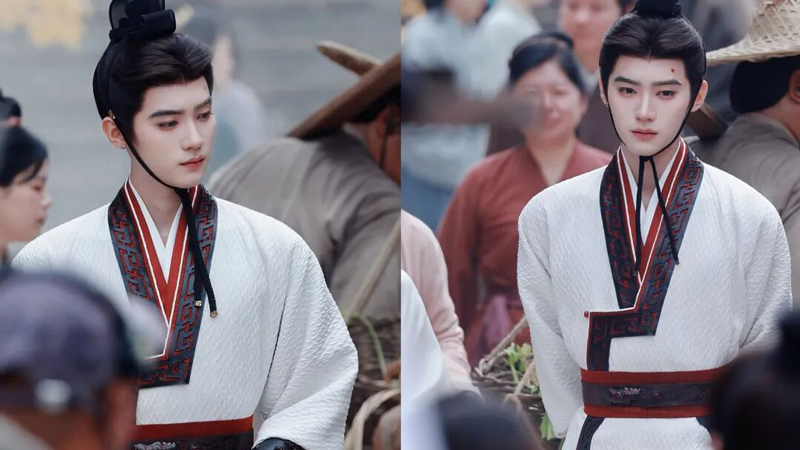
A standard crossed collar involves the left and right lapels overlapping diagonally, creating an open V-shape. The square collar, however, is fundamentally different; its neckline resembles a rectangular frame. The collar edge extends straight and horizontally before the two sides meet at a vertical intersection. The outer lapel first lies flat for a section before turning downwards. This entire structure creates a profile that is as square and defined as a set square, making it the most essential distinction from its slanted counterpart.
In Ashes to Crown, the character’s robe features a white base with intricate red and black geometric “Hui” (回) borders. These patterns are applied along the precise right-angled contours of the square collar, perfectly mirroring the bordering techniques found on Eastern Zhou textiles. The production team refrained from adding unnecessary embellishments like widened collars or decorative tassels, choosing instead to let the clean, architectural lines of the collar speak for themselves.
This design choice reveals a commitment to historical authenticity that is rare in the current landscape of costume dramas. The clean geometry of the collar isn’t just a visual quirk; it’s a historical statement, grounding the character in a specific and often overlooked sartorial tradition.
Archaeological Evidence from the Eastern Zhou
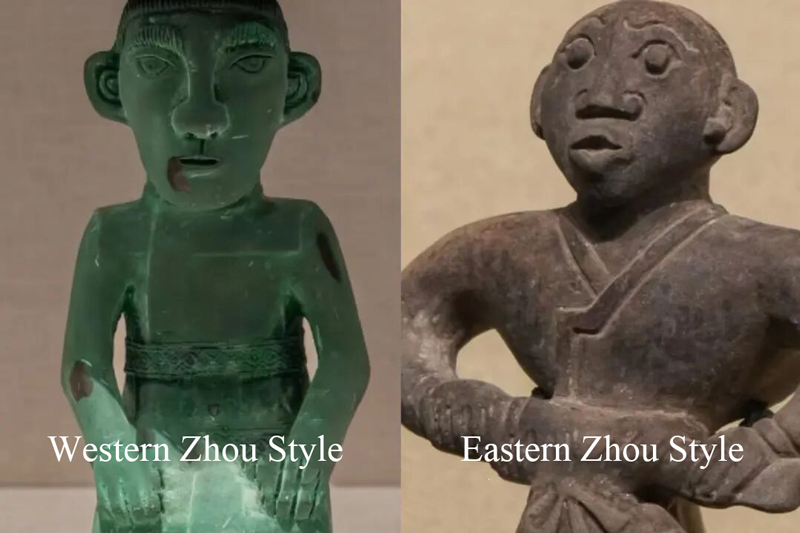
This fidelity to history is not based on mere speculation but on solid archaeological evidence. Numerous artifacts, including lacquered wooden figurines from Jingmen (荆门) in Hubei and bronze sword-bearing figures from Changzhi (长治) in Shanxi, clearly depict the square collar as standard attire. While Western Zhou (西周) collars resembled a rounded overlapping style, the Eastern Zhou saw the emergence of this distinct rectangular form. It was the daily wear of choice for nobles and scholars, serving as regular clothing and casual formal attire. Unlike the heavy, full-length curved-hem robes worn on grand occasions, the square collar was typically paired with a straight-hemmed, mid-length robe. This ensemble was the mainstream fashion for the aristocratic class when receiving guests or during their daily routines.
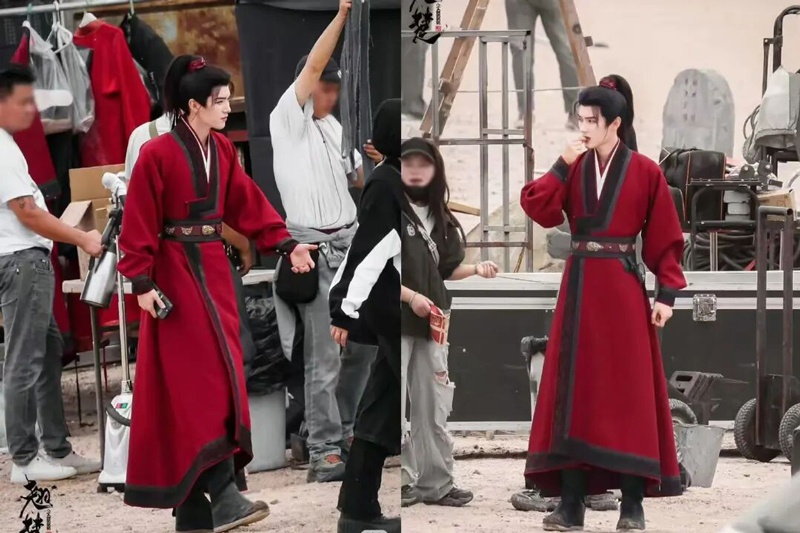
The costume team for Ashes to Crown resisted the temptation to use a generic, mass-produced costume template. Instead, they carefully replicated the collar proportions seen in these ancient artifacts. The width of the collar and the design of its borders were directly sourced from the geometric patterns found on Eastern Zhou bronze tripods. The wide leather belt at the waist is a simplified version of the pre-Qin “Die Xie” (蹀躞) belt, a multi-functional strap system, while the dark, carved cuffs are modeled on the arm guards worn by Warring States warriors. Every piece of this costume, from the collar to the accessories, forms a complete and cohesive historical loop, creating a visual narrative that is both authentic and immersive.
A Rare Gem in the Costume Drama Landscape
In many costume dramas set in the Spring and Autumn or Warring States periods, it is common to see a chaotic mix of Han dynasty crossed collars, Wei and Jin large sleeves, and even Ming dynasty elements. This arbitrary splicing of styles is often misleadingly marketed as “ancient style” design, but it completely disregards the developmental history of Chinese clothing. In contrast, the use of the square collar in Ashes to Crown demonstrates a refusal to casually alter its structural integrity for visual appeal. In today’s fast-paced environment of costume drama production, this dedication to accuracy is exceptionally commendable.

Unfortunately, this meticulously restored pre-Qin collar is a rare sight on screen. While it has appeared in productions like Feng Shen (封神) and Secret of the Three Kingdoms (三国机密), its presence is minimal. Why is it so uncommon? Firstly, the scarcity of intact garments from the pre-Qin period means that restoration relies heavily on pottery figures and bronze artifacts, a process far more challenging than recreating Tang or Song costumes.
Secondly, the audience has been conditioned by homogeneous aesthetics. Producers often fear that niche styles will fail to attract viewers and are reluctant to invest in the research required. This perpetuates a cycle where most dramas set in the pre-Qin era continue to use anachronistic costumes. The square collar’s appearance in Ashes to Crown, despite the show blending styles from the pre-Qin to Eastern Han periods, represents a brave and commendable trial for niche historical costume design.
