
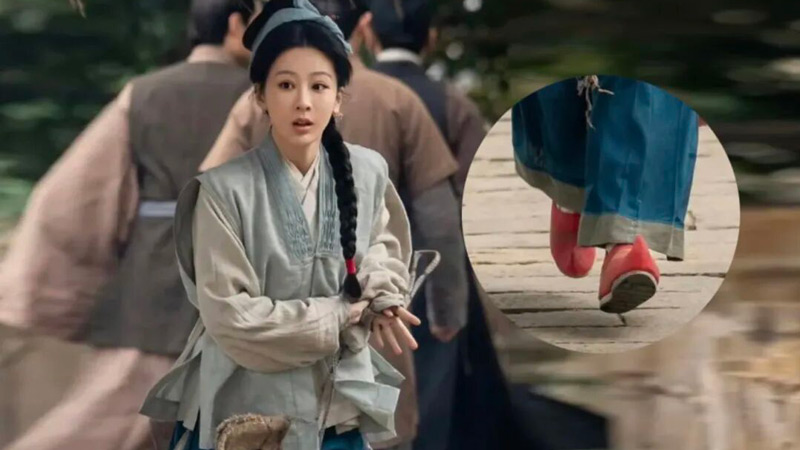
Have you ever watched a Chinese historical drama and suddenly noticed the strange, upturned toes on a character’s shoes? In the recent series The Mo (家业), actress Yang Zi (杨紫) wears a pair of footwear that looks almost like little wooden boats curled up at the front. Viewers often wonder: is this just odd costume design, or is there a real story behind it?
For anyone who has seen flowing long skirts dragging on palace floors, another question naturally follows—how did ancient women walk without constantly stepping on their own hems and falling flat on their faces? The answer lies in those curious upturned toes. This is no mere decoration. It is a clever piece of engineering that once kept generations of people graceful, safe, and properly dressed.
Solving a Trip Hazard
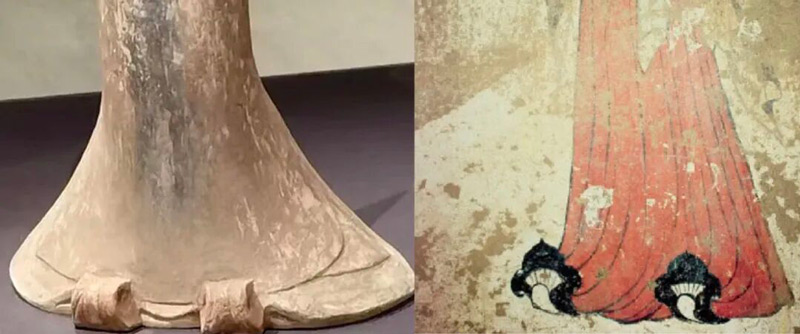
In ancient China, long floor-length skirts were standard for formal wear. But walking in them is like trying to move while a heavy curtain wraps around your ankles. The simple genius of the upturned-toe shoe is that the raised front lip catches the lower edge of the skirt just before it hits the ground. When the wearer takes a step, the fabric rests on that little shelf of leather or silk, sliding forward instead of tangling underfoot. Yang Zi’s character in The Mo wears a version from the Song and Ming dynasties called bow shoe, named for its curved shape like a drawn bow. That curve does one simple job: it holds the hem steady so she never trips.
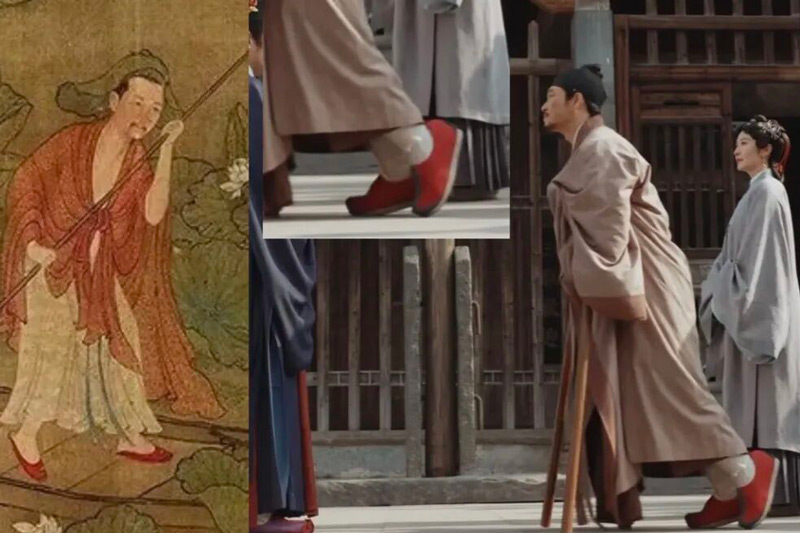
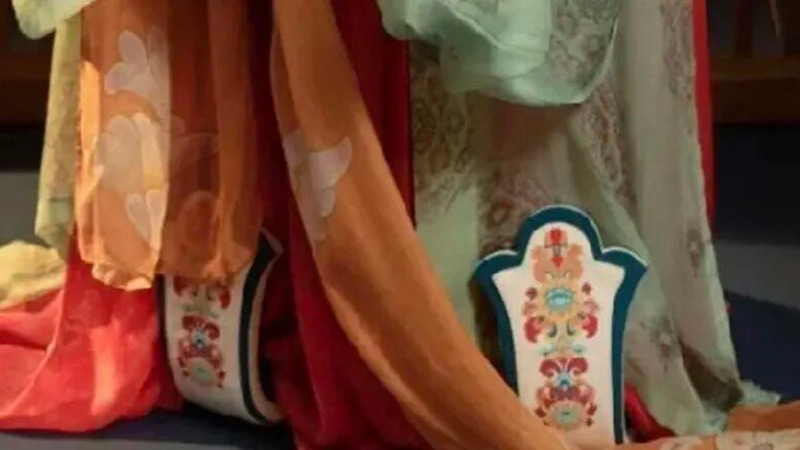
Different eras gave the shoe different names—forked-toe shoe, cloud-toe shoe, platform-toe shoe. But the function never changed. The upturned part is called Xuan (绚), which originally meant a fine, layered silk fabric. Craftsmen chose silk not just because it looks beautiful, but because it is light and stiff enough to keep its shape without weighing down the foot. A heavy shoe would defeat the purpose; the wearer needs to feel the hem glide, not drag. Walking becomes a natural, upright motion. No need to lift the skirt with your hands. No awkward shuffling. Just steady, dignified steps.
This design was not reserved for empresses or noblewomen. Even ordinary women who wore everyday long robes paired their clothes with simple, low-upturned shoes. Men’s black boots, called black official boots, also had a gentle upward curve at the toe. Look closely at a pair of modern sneakers, and you will notice a similar lift at the front. The idea has quietly survived for centuries, hiding in plain sight under our own feet.
Red Shoes and Rituals
Another detail that catches the eye in The Mo is the bright red shoes worn by the third uncle’s character. Why red? It turns out that red was the most versatile color in ancient wardrobes. Whether paired with formal robes or casual clothes, a red shoe added a touch of solemnity without shouting for attention. At the same time, there is something delightfully subtle about it. A long skirt covers most of the shoe, so only the wearer knows that hidden underneath is a flash of vibrant crimson. It feels like a secret joke between the shoe and the ground—practical, yes, but also a little playful. That mix of restraint and hidden joy is very much part of classical Chinese taste.
The upward curve of the toe was never just about function. It also carried a silent reminder of proper behavior. In ancient thinking, a person’s posture reflects their inner character. A shoe that lifts the hem and encourages a measured, unhurried step also nudges the wearer toward composure and self-control. You cannot stomp around angrily in a delicate upturned-toe shoe. The shoe itself demands that you stand tall, walk slowly, and pay attention to every move. In that sense, it was a daily lesson in etiquette, written into the most ordinary object—a pair of shoes.
Experts on historical clothing have studied how the upturned shape affects walking. When the toe points up, the sole naturally forms a gentle arc. This reduces friction against the ground, so each step takes less effort from the toes and the small muscles of the foot. A higher curve means even less energy wasted. But there is a catch. Wearing shoes with an extreme upturn for too long can weaken those same muscles over time. Ancient shoemakers had to balance elegance with health, choosing just the right angle for everyday use versus formal ceremonies. That is why most daily shoes had only a slight lift, while grand ceremonial shoes showed off a dramatic, almost cartoonish curve.
Lost in Modern Life
If the upturned-toe shoe was so clever, why did it disappear from ordinary life? The answer lies in how clothing changed. When Western-style dresses and shorter skirts arrived in China during the early 20th century, the long, dragging hem that required an upturned toe simply vanished. No hem, no need for a hem-holder. Today, even a floor-length evening gown is usually cut to just brush the floor, not pool around the feet. The shoe’s core job became irrelevant. It now lives mostly in historical dramas, traditional costume museums, and a few niche revivalist circles. Yang Zi’s character in The Mo is one of the few modern chances to see it in action.
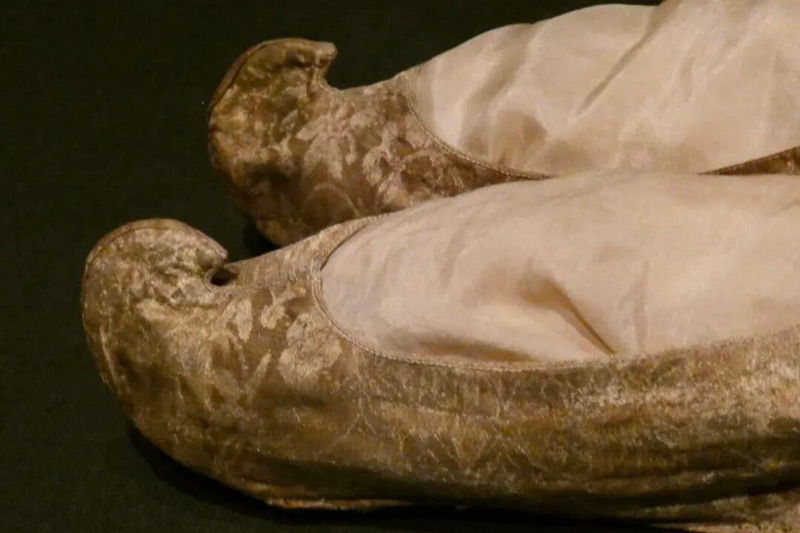
But wait—haven’t we seen this shape before in modern sneakers? Yes. Athletic shoes often have an upward curve at the toe to reduce drag and improve running efficiency. However, those are designed for sports, not for walking around the house all day. Some fashion brands have tried to bring back high-curve toe shoes as a trendy item. They feel light and springy for the first hour, but after a full day of wear, your feet start to ache. Worse, children’s feet are still developing. Putting them in exaggerated upturned shoes can interfere with natural bone growth. The ancient craftsmen knew this: the best everyday shoes had only a gentle curve, not a dramatic one.
Does that mean the upturned-toe shoe has no future? Perhaps not. The need for a shoe that prevents tripping has not disappeared; it has just taken other forms. Non-slip soles, rounded toes, and better arch support are the modern answers to the same problem. But there is something special about the old design. It did not fight against the long skirt. It worked with it, turning a potential hazard into a graceful feature. That kind of thinking—finding elegance inside everyday practicality—is worth remembering. Next time you watch a costume drama and see those strange upturned shoes, you will know: they are not weird. They are one of history’s quiet little masterpieces. Would you wear a pair today?