

Imagine coming home after a long day, collapsing onto a soft couch with your legs sprawled out, phone in hand. That glorious “Ge You Slouch (葛优躺)” feels like freedom. But if you tried that pose in ancient China, especially before the Song Dynasty, you might have been labeled a barbarian—or worse, started a diplomatic incident. For thousands of years, how you parked your body on the floor wasn’t just about comfort. It was a moral statement, a political signal, and a direct reflection of your inner character. So before you time-travel to a Han Dynasty banquet, let’s decode the silent, deadly language of sitting.
1. The Sacred Kneel
The most respected way to sit was called An Zuo (安坐), also known as proper or “upright sitting.” He would kneel on the floor, tuck his lower legs flat beneath him, and rest his bottom squarely on his heels. The spine had to be ramrod straight—no slumping, no leaning. To modern eyes, this looks like kneeling, but to anyone in the pre-Qin era, this was simply “sitting.” The famous idiom “to straighten one’s clothes and sit solemnly” captures this perfectly. It wasn’t just a posture; it was a performance of self-discipline.

Why such rigor? Because the floor was the center of social life. Without chairs or stools (those came much later), everyone from emperors to servants sat on woven mats. The mat itself carried meaning. According to the Book of Rites, the Son of Heaven could sit on five layered mats, a feudal lord on three, and a scholar-official on two. And one golden rule: if the mat wasn’t aligned straight, you did not sit on it. That rule taught a person to value order and integrity, starting from the ground up.
2. Rules of Sitting
Even the direction of your gaze was regulated. The Han Dynasty scholar Jia Yi (贾谊) wrote a whole manual called New Book on Appearance (新书·容经) that broke sitting into four ranks. In “standard sitting,” you looked straight ahead. In “respectful sitting,” you lowered your head slightly and fixed your eyes on the knees of the elder or superior across from you. “Solemn sitting” demanded you drop your gaze to a tiny spot on the floor in front of you. The lowest rank, “humble sitting,” required bowing your head so low that your elbows drooped. Each level was a non-verbal bow.

3. Forbidden Poses
Of course, every rule creates a rebel. The two most offensive sitting styles in ancient China were Jiju (箕踞) and Dunju (蹲踞). Jiju meant sitting on the ground with your legs stretched out and wide apart, like an open winnowing basket. Think of it as the ancient equivalent of the “spread-eagle” subway seat hog. In the Warring States period, doing this in front of someone was a direct insult—a way of saying, “I have zero respect for you.”
The philosopher Zhuang Zi (庄子) famously used it as a shock tactic. When his wife died, his friend Hui Shi (惠施) came to offer condolences. He walked in to find Zhuang Zi sitting in full Jiju, banging on a basin and singing. Hui Shi was horrified. For him, this posture screamed mockery of death itself. But Zhuang Zi was making a point: he saw death as a natural transformation, not a tragedy. Still, the posture alone was enough to scandalize his visitor.

Even inside one’s own home, Jiju was barely tolerated. The philosopher Mencius once walked into his private quarters and saw his wife sitting in that sprawling pose. He was so outraged that he ran straight to his mother and demanded permission to divorce her. His mother stopped him cold. “You entered the room without announcing yourself,” she said. “You were the rude one first.” This story shows how seriously the culture took posture—even as a private habit. It also reveals that women were held to the same standard as men.
4. The Chair That Changed Everything
So when did Chinese people finally get to hang their legs down? The answer arrived on a folding stool called the Hu Chuang (胡床)—literally “barbarian bed.” During the late Eastern Han Dynasty, nomadic tribes from the north brought this portable, cross-legged seat that allowed a person to sit with feet dangling. Emperor Ling of Han became obsessed with it, and soon the court was buzzing with this exotic new way to sit, known as Huzuo (胡坐).
But change didn’t happen overnight. For centuries, high furniture and low furniture coexisted in a wonderfully awkward mix. Look at Yan Liben’s (阎立本) painting Emperor Taizong Receiving the Tibetan Envoy (步辇图). The great Tang emperor sits cross-legged on a sedan chair—still a floor-level habit. Meanwhile, in Lu Lengjia’s (卢楞伽) The Six Worthies (六尊者像), one venerable figure sits on a high-backed chair but stubbornly keeps his legs crossed in the old way. People’s bodies remembered what their furniture had forgotten.
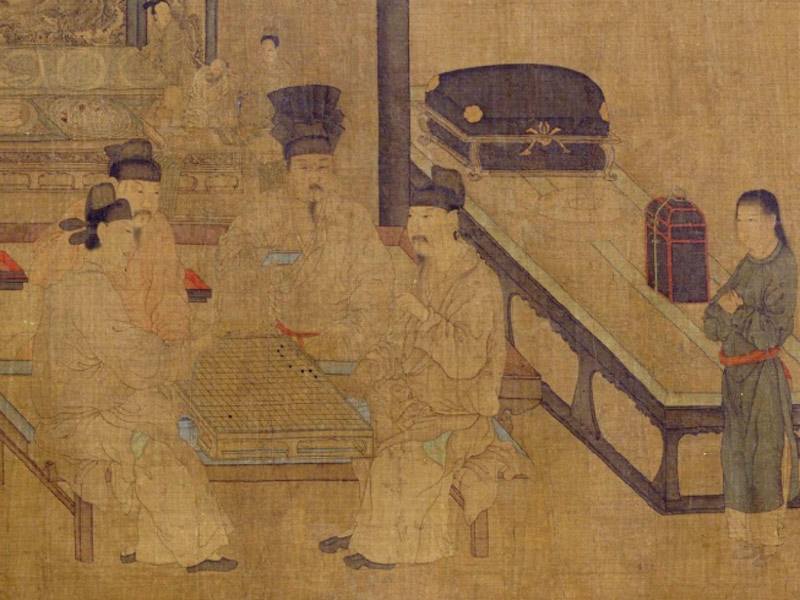
The most vivid snapshot comes from the Southern Tang painter Gu Hongzhong’s (顾闳中) masterpiece, The Night Revels of Han Xizai (韩熙载夜宴图). The host, Han Xizai, an older aristocrat, perches on a grand armchair but still folds his legs like he’s on a mat. Yet right next to him, a young scholar in a red robe sits naturally with his legs hanging down—the “modern” way. That single image captures a generational divide and a quiet revolution. By the Song Dynasty, chairs, tables, and stools had become universal. The thousand-year era of kneeling was finally over. And writing brush calligraphy changed too: with high desks, artists could rest their wrists, losing the floating, free-style strokes of the Wei and Jin periods.