

Imagine your favorite Chinese actress stepping out of a time machine, dressed not in modern gowns but in the silk and armor of ancient dynasties. From the cold sharpness of the Warring States to the florid luxury of Tang, from the quiet poetry of Song to the stately lines of Ming, and finally to the delicate intricacies of Qing—each era demands a different face, a different soul. Who rises to the challenge? Who doesn’t just wear the clothes but becomes the woman of that age? This is not a history lesson. It is a beauty contest across three thousand years. And the answer might surprise you.
Warring States Period
She wears a dark green robe from the Warring States period, gold thread stitching silent patterns at the collar. Ju Jingyi (鞠婧祎) does not smile. Her fingers hover near her lips, her eyes calm but calculating. This is not a gentle beauty. It is the face of a strategist in the dark, someone who has already won before the fight begins. The costume fits her like a second skin—cold, sharp, and utterly magnetic. You cannot look away because you sense the danger underneath.
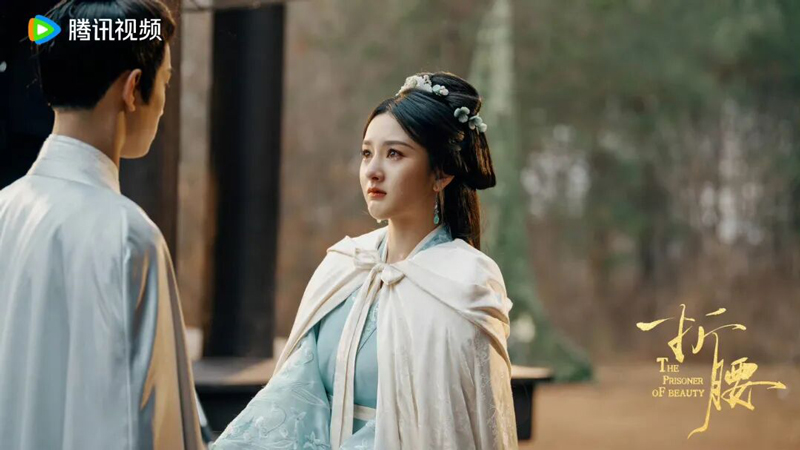
Then there is Song Zu’er (宋祖儿) in The Prisoner of Beauty (折腰). Her Han Dynasty Ruqun (襦裙) layers in soft cream and light blue, gold lines tracing the wide sleeves. She has the bone structure of a classical painting—delicate, almost fragile. But the scene that breaks hearts is simple: she cries in a bamboo forest. Tears hang on her lashes, her eyes red but defiant. Viewers called it “the cry that makes you want to jump into the screen and hug her.” That mix of vulnerability and quiet strength is rare. She is not a blade. She is a water drop that slowly wears down stone.
Zhao Lusi (赵露思) in Love Like the Galaxy (星汉灿烂) takes a different path. Her early “little layered dress” is all light colors and simple embroidery, twin buns making her look like a sweet neighbor. But the wedding scene changes everything. Red silk, gold hairpins, and a smile so bright it launched a thousand fan edits. Zhao Lusi’s beauty is not remote or untouchable. It is warm, approachable, the kind that makes you believe in happy endings. She grows from innocent to resilient, and her costumes grow with her. Yet through every change, she keeps that Han Dynasty dignity—upright, generous, never vulgar.
Tang Dynasty
The Tang Dynasty does not whisper. It screams in peony red and emerald green. Tian Xiwei (田曦薇) in Moonlit Reunion (子夜归) wears a chest-high Ruqun as bright as Chang’an street markets. A sparkling Huadian (花钿) adorns her forehead, her eyebrows curved like distant mountains. When she laughs, she radiates the confidence of a Dynasty that ruled the Silk Road. Viewers say her face was “born for Tang”—round, full, with a girlish charm that somehow also feels regal. She moves like a dancing butterfly, but a butterfly made of gold thread and precious gems.
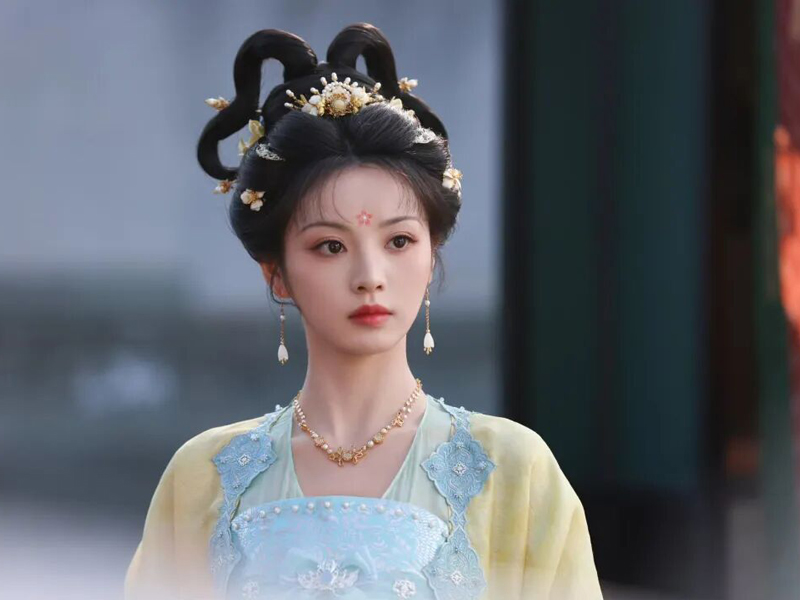
Yang Zi (杨紫) in Flourished Peony (国色芳华) takes Tang opulence to another level. Her wedding costume pairs red and green in beaded embroidery, a jeweled crown on her head, a round fan half-covering her face. The eyebrows are painted as thin willow leaves, a tiny flower between them. Later, as a flower shop owner, she wears a yellow-green Ruqun with half-up hair and pink blossoms—elegant yet lively. By the end, she is covered in peonies from head to toe. Internet comments say, “She wore the peony itself.” Yang Zi’s beauty is not subtle. It is loud, proud, and impossible to ignore. That is exactly what Tang demanded.
Song Dynasty
After Tang’s fireworks, Song Dynasty beauty is a cup of clear tea. Liu Yifei (刘亦菲) in A Dream of Splendor (梦华录) wears Song robes in muted creams and pale greens, with only faint dark patterns at the collar. Her hair is half-up with simple silver pins, her lips a soft bean-paste color. She does not need dramatic lines or bright hues. She just stands there, and you believe she walked out of a Song painting. Her beauty grows on you slowly, like the aftertaste of good tea. One viewer wrote, “She doesn’t act. She just exists, and that is enough.” That is the essence of Song aesthetics: less is infinitely more.
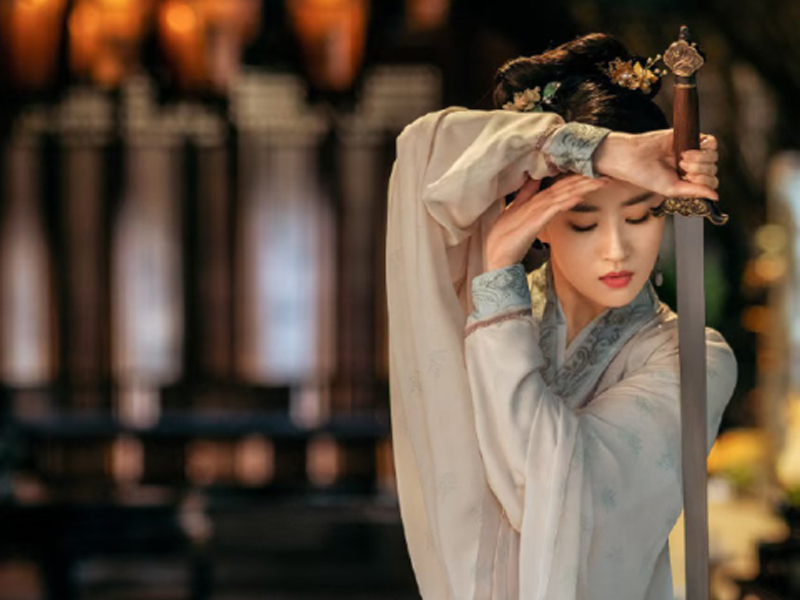
Wang Churan (王楚然) in Are You the One (柳州记) adds a twist. One of her costumes is a green gauze robe that fades from light spring green to deep jade, the hem floating as she walks—as if she wrapped a whole season around herself. Another is a white long coat with silver thread hidden in the collar, catching the lamp light like scattered stars. Song beauty is subtle, but it is not boring. Wang Churan proves that restraint can still feel magical. Her face is soft but not weak, her gaze steady but not cold. She embodies the Song ideal: a woman of inner cultivation whose grace comes from within, not from display.
Ming Dynasty
The Ming Dynasty loved rules. Standing collar, long gown, horse-face skirt—everything measured, everything proper. Chen Duling (陈都灵) wears it like a scholar. Her long gown in pale blue, her wide sleeves flowing as she walks, she looks like a talented woman from a Ming painting. Her natural cool elegance gains a layer of intellectual refinement. She does not need to act brilliant. She looks it.
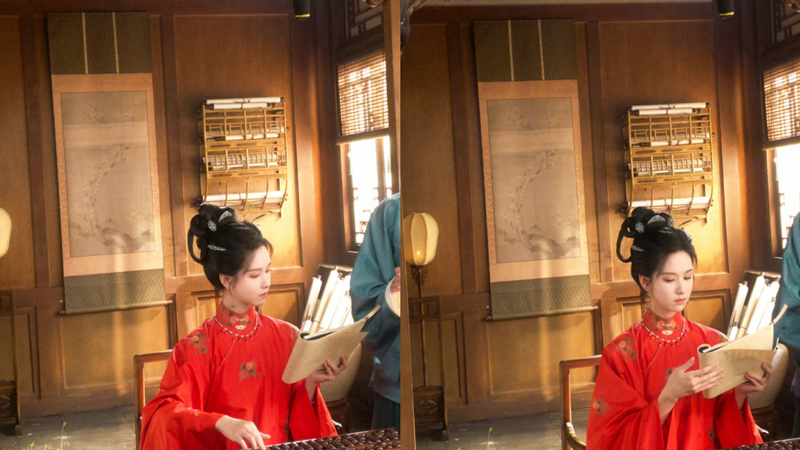
Guli Nazha (古力娜扎) in Glory (玉茗茶骨) goes bold. A red robe with beaded and embroidered cloud shoulders, a magnificent floral crown. She is gorgeous yet solemn, the kind of presence that commands a room without saying a word. Then there is Liu Shishi in The Imperial Doctress (女医明妃传). She reportedly wears over thirty Ming outfits in the drama—from standing-collar large-sleeve robes to padded jackets and horse-face skirts. She plays a female doctor who grows from a playful girl to a battlefield healer. Her costumes change color and cut to match her journey, but the core never wavers: the dignified, generous spirit of a Ming gentlewoman. Many Hanfu enthusiasts call this drama a textbook for early Ming restoration. Every outfit is a screenshot-worthy lesson.
Qing Dynast
The Qing Dynasty court loved code. And no one played the code better than Sun Li (孙俪) in Empresses in the Palace (甄嬛传). Early on, as a fresh concubine, she wears pink Qing banner dress with a simple Liang Ba Tou (两把头), innocent as a newly opened flower. Later, returning as the mighty Empress Xi, she appears in bright red robes, dramatic earrings, and kingfisher-feather headpieces. Her eyes have lost all warmth. They hold only cold, awe-inspiring power. The costumes tell the story: pink to purple to gold, sweet girl to ruthless survivor. As one fan put it, “The clothes act in this drama. Just look at the color, and you know where she stands.”
But Qing beauty was not only in the Forbidden City. Qing Han women—Han Chinese women living under Qing rule—wore a different kind of dress. Loose jackets or padded coats over pleated skirts, more everyday, more human. Lu Yuxiao (卢昱晓) once shot a set of photos in this style, fresh and striking. Meng Ziyi (孟子义) wore a bright red pleated skirt, held a round fan in an old courtyard, and suddenly became the image of a cultivated lady from a gentry family. This beauty has no palace pressure. It carries the warmth of smoke from kitchen chimneys, the sadness of a woman waiting by the window. It is not grand. It is real.

From the cold blade of the Warring States to the intricate power of the Qing, from the sharp strategist to the warm neighbor, from the peony queen to the quiet tea drinker—each actress found a Dynasty that fit her like a key in a lock. Some beauty cuts. Some beauty blooms. Some beauty lingers on the tongue long after the cup is empty. So who is your timeless favorite? The cold strategist Ju Jingyi? The peony queen Yang Zi? The poetic Liu Yifei? Or the stately Liu Shishi? The answer tells you not just who you find beautiful, but what kind of beauty you truly love.