
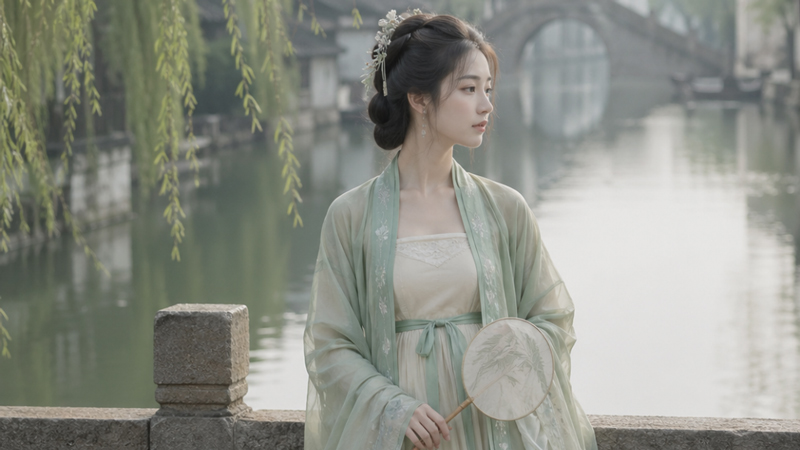
She does not compete. She does not grab attention. She does not make a scene. Standing there in silence, she becomes unforgettable. A recent online debate asked which dynasty’s Hanfu looks best. Fans of Tang-style Hanfu praised its grandeur. Supporters of Ming-style Hanfu championed its richness. Yet the winner was neither. It was Song-style Hanfu. Why? Because it never tries to outdo anyone. No wider hemlines, no denser embroidery. It simply exists. And that quiet confidence, as one commenter put it, “does not stun at first glance, but then you cannot look away.” What follows is a closer look at why this 12th-century aesthetic still turns heads today—without ever raising its voice.
Modest Cut
When most people picture Hanfu, they imagine flowing sleeves and ethereal layers. Song-style Hanfu rejects that entirely. The upper body pairs an inner Mo Xiong (抹胸)—a wrap-around breast cover—with a long outer jacket called Bei Zi (褙子). The Bei Zi comes in two lengths. A long one grazes the ankles, its hem fluttering gently as she walks. A short one sits at the hip, far more practical for daily life. Neither screams for attention.
Below the waist, two options dominate. The Liang Pian Qun (两片裙), or “two-panel skirt,” does not flare out like a pleated fan. Instead, it wraps front and back with clean lines. The effect? A silhouette that slims the body rather than drowning it. The other choice is Song Ku (宋裤), a clever construction: an inner open-crotch Ku (袴) covered by an outer high-waisted, side-slit trouser. During the Song Dynasty, women wore a skirt over it, so the Song Ku remained hidden—but it defined the entire outfit’s structure.

What is the final look? Fitted yet comfortable. Trim yet unpretentious. Four Chinese characters sum it up: Wen Qi (文气)—a scholarly, refined air. No drama, no excess. Just a quiet elegance that feels both ancient and oddly modern. That is the magic of the Song silhouette. It does not shout “look at me.” It whispers “remember me.”
Soul of Restraint
Why does Song-style Hanfu look so restrained? The answer lies in the turbulent history that birthed it. After the Tang Dynasty fell, the Five Dynasties and Ten Kingdoms period brought chaos. Then Zhao Kuangyin (赵匡胤) launched the Chenqiao (陈桥) Mutiny and founded the Song Dynasty. From that moment, the national aesthetic pivoted—away from Tang’s bold opulence, toward something quieter, more introspective.
This shift had a powerful intellectual driver. Neo-Confucianism, which emphasized self-cultivation, restraint, and inner virtue, rose to prominence. Its values seeped into every aspect of life, including clothing. Garments became simpler, colors more subdued. No loud crimson or electric green. Instead, Song-era fashion embraced pale, muted tones: Ou He Se (藕荷色), a soft lotus pink; Yue Bai Se (月白色), a moonlit white; Mei Zi Qing (梅子青 ), a plum-green.
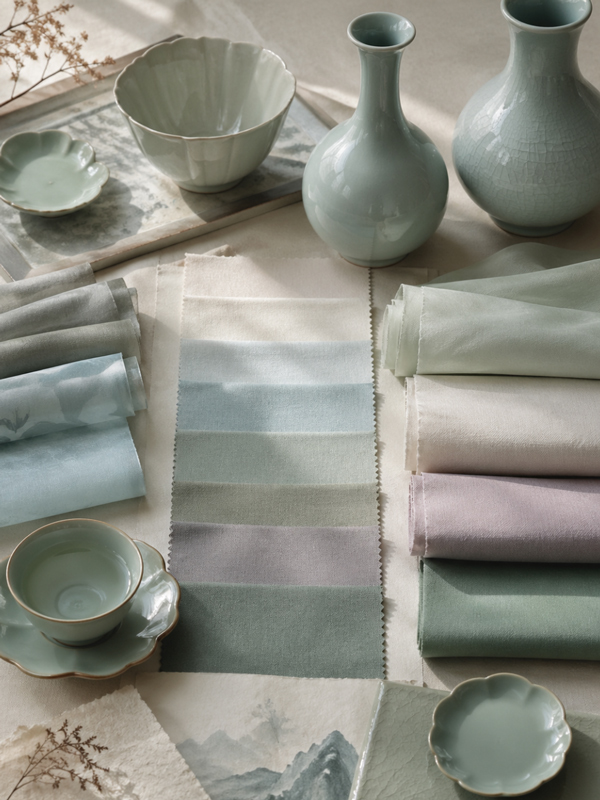
These were the very colors found on Song celadon porcelain. Emperor Huizong (宋徽宗 ), himself a painter and calligrapher, pursued a specific aesthetic for royal ceramics—“sky after rain” blue-green. That same restrained palette became the hallmark of Song clothing. Some call it “China’s own Morandi colors,” after the Italian painter Giorgio Morandi who favored low-saturation, dusty hues. There is truth to that. Both take vibrant colors and dial them down, making them gentle, enduring, never jarring. Wearing such shades sends a message not of “I am beautiful” but of “I have substance.”
Quiet Comeback
Over the past two years, the Hanfu community has witnessed a clear trend: more people are reaching for Song-style Hanfu. Previously, Ming-style Hanfu dominated because the Mamian Qun (马面裙), or “horse-face skirt,” paired effortlessly with modern blouses and T-shirts. Its bright colors photographed beautifully. Tang-style Hanfu also had a loyal following—its lavish ornamentation made it perfect for stage performances and festivals.
But both schools share a fatal flaw for daily wear. They are too demanding. They accentuate every body curve in unforgiving ways. They feel “ceremonial,” out of place in a coffee shop or a commute. Song-style Hanfu flips the script. It is tailored but not tight. It is understated but not bland. The silhouette forgives a range of body types. The restrained colors never clash with modern interiors or streetwear. You can wear a Bei Zi over jeans and look intentional, not costumed.
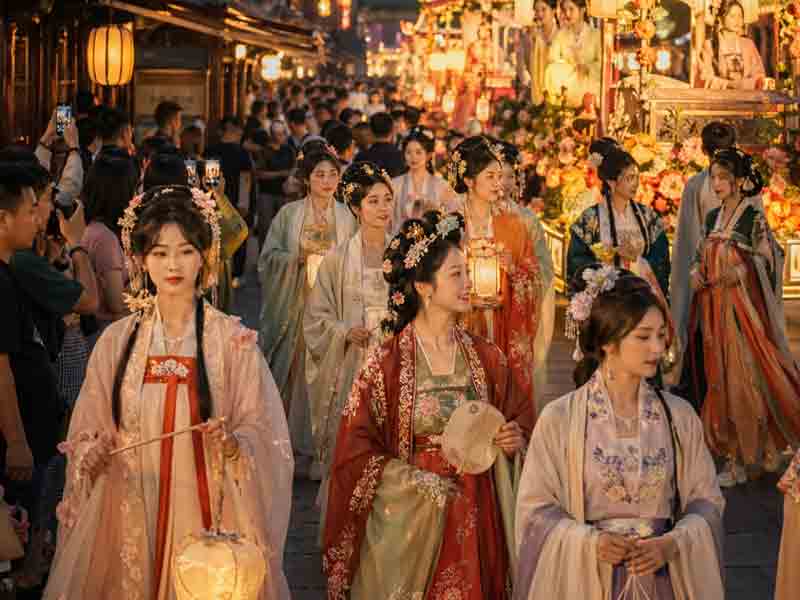
More importantly, Song-style Hanfu captures a contemporary mindset. Young people today no longer crave loud logos or flashy displays. They want clothes that say, “I have taste, but I do not need to prove it.” It is the difference between shouting and speaking. The Song aesthetic understands that. It offers presence without dominance. Grace without arrogance. That is why, after a thousand years, the quiet lady of the 12th century is finally having her moment—and she is winning without ever raising her voice.