
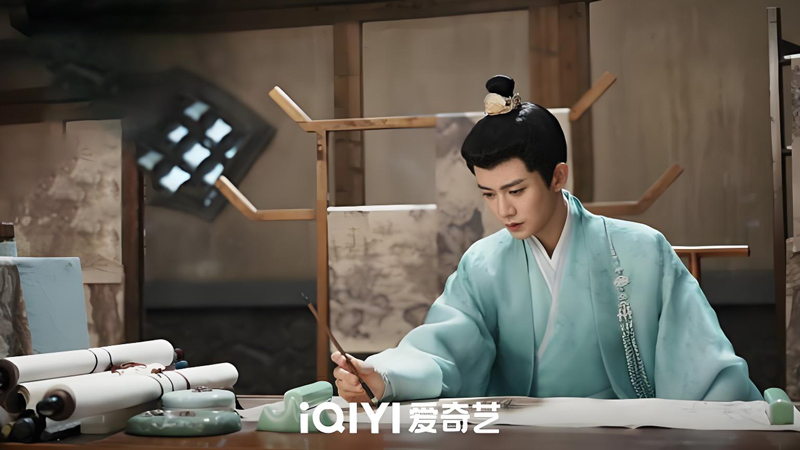
In the drama Fate Chooses You (佳偶天成), Lu Qianqiao (陆千乔) saves Xin Mei (辛湄) not once, not twice, but three times. He erases her memory to protect her, heals her wounds when she’s dying, and even risks his own kind’s secrets to pull her from the edge of death.
Yet every time, Xin Mei repays him with accusations, cold shoulders, and sharp words. She knows exactly who he is—a Zhan Gui (战鬼), a member of the feared War Ghost tribe—and she uses that identity as a weapon against him. Why does gratitude never enter her heart? What makes her blind to his actions? The answer lies not in his deeds, but in her own unresolved pain and a history she refuses to separate from the man standing before her.
The Poisoned Candy
Take the scene with the sour tamarind candy. After Lu Qianqiao drives away Xia Xuanzi (夏玄子), who nearly stabs Xin Mei through the heart, she pulls out a piece of Suan Jiao Tang (酸角糖) from Bei Xiang (北襄). She unwraps it and offers it to him. A simple test. She knows that Zhan Gui people cannot taste sweetness—everything they eat rots on their tongue. Lu Qianqiao, fully aware of her suspicion, takes the candy without hesitation. He puts it in his mouth. And he says it’s sweet.
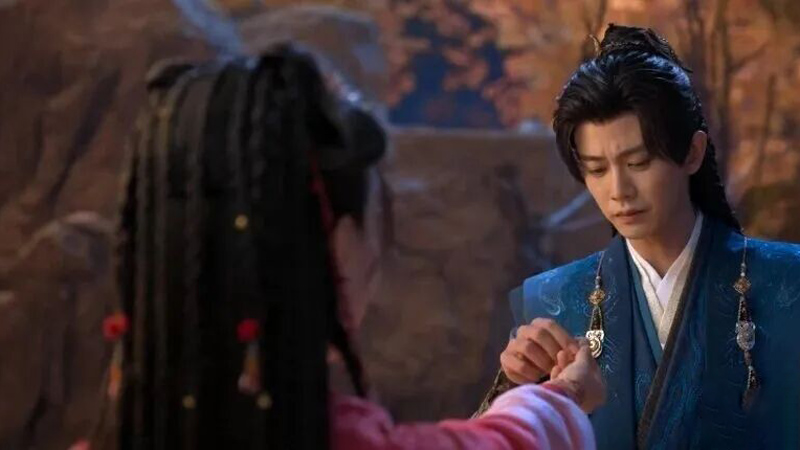
But the candy is sour. It has no sugar in it. His taste buds should have screamed bitterness, but his heart translated the gesture into something else entirely. He wanted so badly to believe in her kindness that his body lied for him. Xin Mei, however, does not soften. Instead, she pushes harder. She tells him she visited his mansion again—all the paintings in his room are black and white. He cannot see colors either. She recalls how he only drank wine in Chongling (崇灵) Valley, never ate food, because food to a Zhan Gui tastes like decay.
These are not discoveries that lead her to compassion. They become evidence. Evidence that he is different, broken, monstrous. She does not ask why he suffers in silence. She does not wonder how lonely it must be to live in a world without flavor or color. She only asks: why did you hide this from me? Why are you so terrifying? The candy falls to the ground, uneaten except for his desperate bite. And she walks away, still holding her anger like a shield.
The Weight of History
Xin Mei’s hatred is not born from nothing. The Zhan Gui tribe, decades ago, waged war on the mortal realm. They killed thousands. They ripped trees from the earth with a thought and turned seeds into weapons. The Xian Men (仙门)—the immortal sects—fought back and lost every last disciple protecting ordinary people. Xin Mei’s own sect, the Xinxie (辛邪) Village, was wiped out. Her senior brothers died. Her home burned. And in her memory, every Zhan Gui is a beast. Every single one, including Lu Qianqiao.

But here is the problem. When that war happened, Lu Qianqiao was either a newborn or not even born. He did not order the attacks. He did not sharpen a single blade. He grew up in a world that had already branded him guilty by blood. He never hurt a mortal. Instead, he hunted criminals. He saved villagers. He spent his life trying to prove that he was not his ancestors. And yet, Xin Mei clings to the past because losing her sect brothers left a wound she never closed.
Grief is a strange thing. It needs a target. Without one, it turns inward and destroys the one who carries it. Xin Mei cannot fight the dead. She cannot bring back the Xian Men. But she can point at Lu Qianqiao and scream. She can blame him for the sins of his race. She never asks herself: what would I have done if I were born into that tribe? Could I have chosen differently? The war ended before he could speak. But in her eyes, he wears the same collar as the murderers.
A Selfish Justice
The deepest irony is that Xin Mei is no saint herself. She once married a death-row prisoner to help a man named Bai Zongying (白宗英). She broke into officials’ mansions and killed them because they falsely accused Lu Qianqiao. Not out of love for him—out of a twisted sense of fairness. She never wrote a letter to the emperor. She never tried the legal way. She just took lives with her own hands and called it justice.
When the immortal sects forced peasants to plant herbs for the Buxiu Dan (不朽丹)—the elixir of immortality—and the emperor taxed the people for it, she smashed ten palace jade tablets in anger. That was her rebellion. She vented. She broke objects. But she never raised her sword against the Xian Men. She never fought the real enemy. Because that would be dangerous. That would risk her life. So she chose the safe anger: blaming a man who saved her again and again.

Without Lu Qianqiao, Xin Mei would have died in the capital, beaten bloody by the immortal sects. Without him, she would never have left Chongling Valley after being hit with the Word-Follow spell. Without him, Xia Xuanzi’s blade would have been her last sight. He pulled her from every abyss. He asked for nothing in return except to be seen—not forgiven, just seen. And she refused. She called him a beast while standing, breathing, and walking because of his hands.
People are selfish. That is human. But to cut everything with one knife—to judge a man for his birth, not his choices—is not justice. It is cowardice dressed in grief. And the real question is not why Xin Mei hates Lu Qianqiao. The real question is: how could a man with so much kindness ever fall in love with someone so blind?