

Just after the Shang Si (上巳) Festival, a short video featuring Lan Yingying (蓝盈莹) went viral. She played the role Huanbi (浣碧) in the hit drama Empresses in the Palace (甄嬛传). In the clip, she wears a modified Phoenix Dress of the She (畲) ethnic group. Dancing with She girls, she holds a wood knife and a bamboo rod. The moves are sharp, the outfit is gorgeous. Netizens didn’t just praise her beauty. They said instead: “This wave of ethnic cultural confidence wins!” Lan Yingying is She herself. For years, she has quietly promoted her people’s traditional clothing. This time, her post-festival buzz gave the culture a warm, powerful boost.
Her Roots, Her Pride
Many didn’t know Lan Yingying is She. She never made a big announcement. She just kept wearing and sharing She attire. This Shang Si Festival, her Phoenix Dress was modernized but faithful. The headpiece and silver ornaments were simplified. Yet the patterns on the lapel strictly followed She tradition. That’s the key: she avoided a common trap in traditional clothing promotion. You don’t need a 100% replica of ancient garments to pass on heritage. You need to make traditional elements fit modern taste. That way, more people become willing to learn and accept.
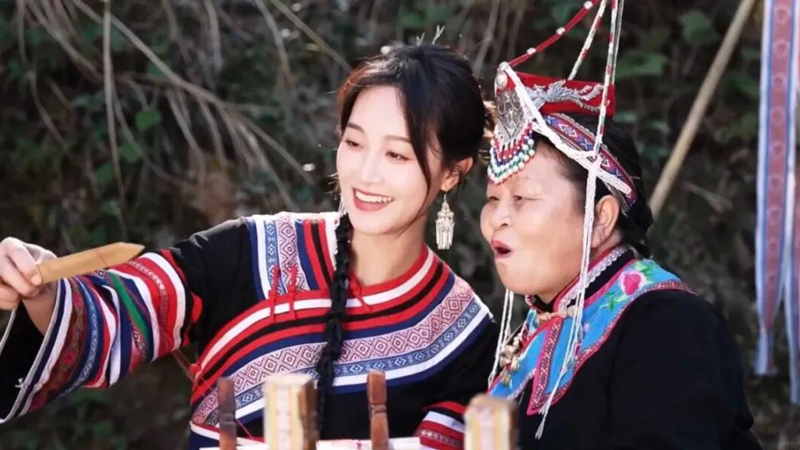
The Phoenix Dress is the most iconic She garment for women. It carries the group’s cultural memory. Traditional Phoenix Dress uses indigo and blue hemp cloth woven by hand. The lapel and cuffs are trimmed with colorful ribbons. The tall headpiece symbolizes the phoenix crown. The silver jingles hanging all over the body represent the phoenix’s song. Every detail hides the She people’s wish for a better life. Lan Yingying’s version keeps these spirits alive while ditching unnecessary heaviness.
She didn’t just pose for photos. She danced two She folk dances: “Da Qiang Dan” (打枪担, beating the spear) and group dance. One hand held a chopper, the other a bamboo gun pole. The brisk moves paired with the rich costume created a striking contrast. It had the deep weight of intangible cultural heritage and the lively energy of modern trends. Viewers called her “She Princess” not because of her fame, but because she has worked tirelessly to promote her native dress. That’s respect earned, not given.
Hanfu’s Hard Truth
She attire isn’t alone. Many traditional clothing cultures have been forgotten and then revived. Hanfu is the most prominent example. On streets and in parks, you occasionally see young people in Hanfu. During spring, cultural tourism sites host Hanfu parades and gatherings. It looks lively. But beneath the surface lies a deep problem. Take Caoxian (曹县) County in Shandong. It boasts annual Hanfu sales of 13 billion yuan. Yet it faces limited use scenarios, lack of original designs, and poor quality standards. Many Hanfu pieces on the market use rough fabric and don’t follow proper forms. Cheap competition and sameness are rampant. As a result, many people see Hanfu as “pretty but not practical.”

Some argue Hanfu is too cumbersome for modern life. Others think wearing it is just showing off. But Hanfu was never meant to be museum relics. It is a cultural carrier of “the beauty of clothing and decoration.” The crossing collar with right side over left holds ancient people’s manners. Every stitch, every line, every pattern carries the craftsmen’s ingenuity. These shouldn’t stay only in display cases. Neither should they be labeled as “niche” or “only for ancients.”
The harsh reality is that without everyday use cases, traditional clothing struggles to survive. Mass production cuts corners. Copycat designs flood the market. Original designers get squeezed out. Consumers buy cheap Hanfu for one photoshoot and never wear it again. That cycle hurts both the artisans and the culture. People start to think tradition equals impractical. But that’s a lie born from poor execution, not from the clothes themselves.
A Smarter Path
Lan Yingying’s approach gives us a good lesson. Passing on traditional clothing never means unchangeable copying. It means adapting wisely. Her modified She outfit keeps core patterns and craftsmanship but simplifies the busy decorations. That makes it fit modern life scenes better and easier for young people to accept. The same is happening with “Hanfu-element fashion” like the Mamian (马面) skirt from the Ming dynasty. Designers blend it with daily commuting elements. Hanfu no longer limits itself to festivals and scenic spots. It enters ordinary people’s real lives.

This “keep the core, innovate the form” strategy preserves the cultural roots while letting tradition move with the times. That is the true meaning of heritage. We don’t have to force ourselves to wear traditional clothes every day. We don’t need 100% replication. Even just learning a bit about the patterns’ meanings, recognizing one more Hanfu shape, respecting the artisans who stick to old techniques—that is already a form of passing on.
The protection of traditional clothing is not about freezing it in one unchanged shape. It’s about making sure it can still be seen, loved, and passed on through the tides of time. As Lan Yingying shows through her dance and her dress, what’s ethnic is what’s global. Only by holding onto these cultural roots can the beauty of Chinese clothing keep shining through the years. Each of us can take a small step. Learn one fact. Share one photo. Respect one craft. That’s how tradition survives—not as a frozen relic, but as a living, breathing part of our wardrobe and our world.